
Doylestown Fire Co. No. 1 (An Abbreviated History)
by Mrs. Harry, (Judy) McCann and F. William Cope (amendments by E. Loux)
The earliest recorded fire in our vicinity was in 1809, when David Kirkbridge’s farmhouse was destroyed. But it wasn’t until after the fire at Crispin Blackfan’s house on East State Street in 1822 that action to organize fire fighting began in earnest. The Doylestown Fire Engine Company was formed in 1822 and held its organizational meeting in January 1825 and a subsequent issue of the Patriot reported that an engine and equipment were ready for any emergency. The firehouse was then located in a building at the corner of Pine Street & Garden Alley.
The unit officially reorganized in 1834 as the “Friendly Fire Company” in time to fight one of the Borough’s most disastrous fires of the 19th century in 1836. That fire caused extensive damage to the building housing the “Doylestown Democrat,” formerly located in a building on Main Street across from the Fountain House (now Starbucks).
By the fall of 1845, Friendship’s assets had been transferred to the Borough, as they too had become defunct. In 1868, the Doylestown Engine Company formed and accepted the new No.1 fire engine, leather hose, cart, and equipment from the Borough.
Our present organization, Doylestown Fire Company No. 1, was originally organized on August 4, 1879, with 25 charter members. This company also went through a reorganization. A new constitution and bylaws were adopted in October of 1893, and, by year’s end, a new ladder wagon was ordered. Our articles of incorporation were approved by the county court on January 14, 1895, and we have continued to serve the community ever since.
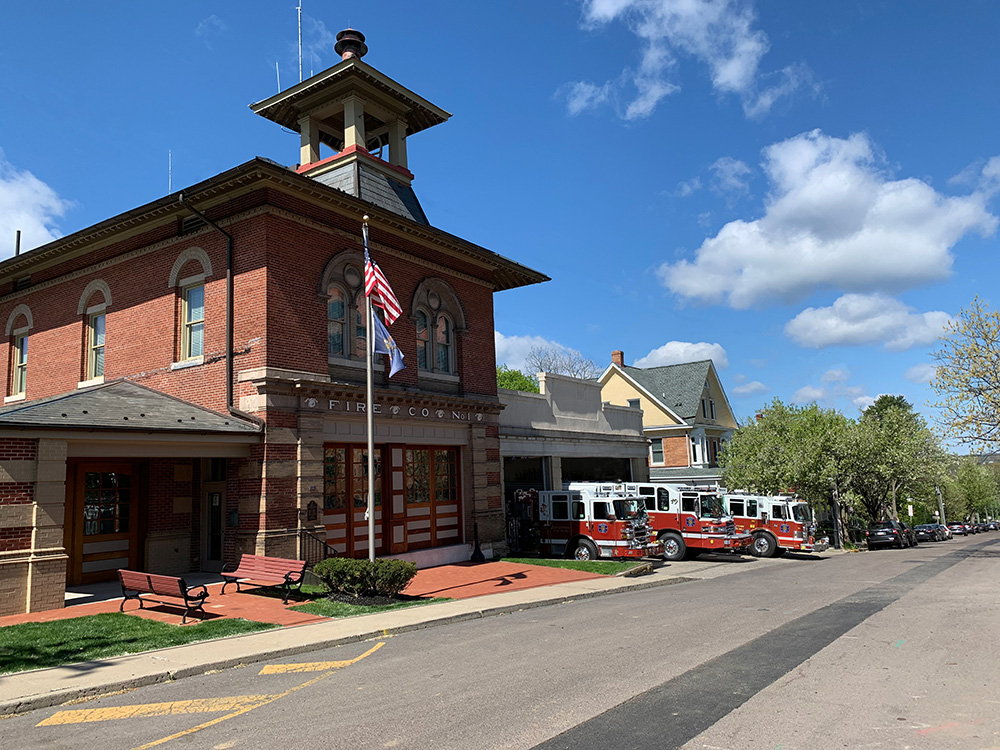
The land for our firehouse on Shewell Avenue was purchased in 1900, only two years after the street opened. Plans for the Fire House were drawn by Oscar Martin, a Doylestown architect, during the spring of 1902, and the cornerstone was laid on August 20. Our housewarming was held on January 26, 1903. The project cost just over $8,000, including plumbing, heating, gas lights, and a fire bell.
Early firefighting equipment consisted of horse-drawn wagons, ladders and hooks, horses, buckets, and a lot of manpower. The engine in use during the late 1840s required at least eight men to work the hand pump. If a fire scene was nearby, the firefighters would sometimes pull the equipment by hand rather than take the time to harness a horse. Some of our old firefighting apparatuses were donated to the Bucks County Historical Society and are housed at the Mercer Museum in Doylestown.
Horse-drawn equipment was slowly phased out in the early years of the 1900s. Our first motorized apparatus was a 1914 Simplex chemical truck. The second was an auto-pumper that was placed in service in early 1915. The pumper was capable of 500 gallons per minute and was manufactured by the Waterous Company. Both trucks were built locally by John Rufe & Sons. Today, our modern pumpers are capable of pumping up to 2000 gallons per minute and are still equipped with Waterous pumps.
In 1923, we purchased our third motor-driven fire truck, an Ahrens-Fox, capable of pumping 1,000 gallons of water per minute, for $13,400; a new pumper now can cost over $800,000 fully equipped, while ladder trucks are priced at nearly $2,000,000. Our “Fox” is still in our inventory, tested yearly, and can still pump 1000 gallons a minute.
Other trucks have come and gone over the years as we have continued to upgrade our capabilities. Of note are the 1938 Hale Pumper, which is still owned locally by the Tilley family, and the 1968 Hahn Pumper, which is owned by the Loux family. Both can be seen at parades and other fire company events. A full account of our apparatus is on our website under the fleet tab (apparatus history).
In 1950, the Ladies Auxiliary of the Doylestown Fire Company was formed to financially assist and aid the fire company. Their fundraising activities include pancake breakfasts and other events. In 1994, “Ladies” was dropped from their organizational name. The Auxiliary operated a canteen step-van from 1980-2018, which was capable of serving meals at major fires and disaster scenes. Currently, they provide fundraising support.
A major change in firefighting communications came about in 1955 when the company acquired the first mobile radios. Our base station went “on the air” with the call letters KGD-655, and two of our trucks received mobile radios. Today, all of our apparatus has the latest methods of communications, including encrypted radios and computers in them.
Looking to the future, as the rural nature of the area surrounding Doylestown continued to be developed, the company graciously accepted donations of land on Warden Road from Mr. George Hart and Mr. and Mrs. David Burpee. Our Warden Road Station, Station 79, was dedicated September 9, 1978, and operates as our second, first-out station.
Firefighting and rescue work have become a family tradition with many of our volunteers. Today, we have second, third, and a few fourth & fifth generation members in the Company. We have active, associate, contributing, and life member categories to honor those members who have faithfully volunteered their time to our cause for more than 20 years. Our membership of over 100 unpaid volunteer members stands ready to respond at a moment’s notice, any time of day or night, in the proud tradition of American volunteerism.